

012: pArAS0ciAL Activity
When proximity isn't love.


Cold Open
Am I okay? (None of us are)
A lot of the time, I’m resentful.
I probably wear it well because if you talk to me, you might not notice. Maybe that’s not actually wearing it well. It’s just masking.
Under the surface, though, I’m upset about so much, and in no particular order. I hate the state of the world and the fact that straight men make dating a joke. I’m not even dating and I’m peeved by this! I’m mad that the air’s biting, and people live on the street. I’m angry about “allowing” myself to be mistreated in a past relationship.
It’s frustrating that, as a woman, especially as a Black one, I think about my safety all the time.
I don’t have a stack of money to fix all my loved ones’ problems, and that’s maddening, too. I hate that my friends are trying their best, and it never feels like enough. I also don’t love that I rely on my phone for comfort, so now I’m trying to detach, but never too much because I’m an online writer.
Maybe once a day, I can feel the pressure of water welling behind my eyes, my chest tightening, and I ask myself: Am I okay? Why do I feel like I’m in crisis mode? Nothing bad is happening to me in this moment.
Then I remember that we’ve all been through a pandemic. And so much else. The earth is not healing.
Underneath the snark, the jadedness, or the flat-out rage, lies heartbreak, fatigue, and a longing for safety. I know I’m not alone. My friends tell me so. They’re willing to admit that they’re wrestling with the weight of the world, too. Through the hurt and frustration, at least we got each other.
Solange and Wayne said it best: I got a lot to be mad about. We all do.
Here’s a playlist to remind you that whatever angst you’re carrying in these trying times, someone else is feeling it too.
Mad. | Apple Music
Girlfriends
The switch-up
We haven’t discussed this in the newsletter because, honestly, it’s not relevant to either of our current lives. And…sometimes there’s a level of protection about bringing women’s business online because of misogyny. But lately, watching whatever’s happening between Megan Thee Stallion and GloRilla unfold online makes me think about how quickly–and sometimes insidiously–friendship can turn into something else.
I want to preface this by saying I’m actually a huge GloRilla fan. Honestly, I probably listen to her music more than Megan thee Stallion. There’s a jenny say quack in her Memphis grittiness that has always appealed to me, and I loved the breath of fresh air she brought to the girlypop rap game. When Glo linked with Meg, it felt like the beginning of an unstoppable duo. They released song after song, featured each other on albums, partied and vacationed together, and Megan even had Glo in Beyoncé’s face. Very much, “Glo is Meg’s son.”
Which is why now, the switch-up is…crazy. From posting content with Daystar Peterson’s songs in the background, to performing with an unashamed abuser, to liking posts that disparage Megan, it’s sort of like…what happened?
Another caveat (because I have to spoon-feed nuance online): we don’t know these people. We know that. We know this is all pArAS0ciAL. But, we can put the public pieces together and see that all is not good in the neighborhood—and seemingly, for no reason.
What happens when you have a friend who…isn’t really your friend? When someone gets close to you, not because of you, but what you can do for them?
A wise person learns from their mistakes, but a wiser person learns from the mistakes of others. This isn’t to say Megan and Glo’s relationship was a mistake (again, I don’t know these people), but it’s a reminder to audit your own friendship circle.
Who celebrates your wins? Who shows up in the dark moments? Who speaks your name positively in rooms you’re not in? Who defends you when you don’t even realize it? Who lets you just be…you? Unmasked and unabashedly you. Assessing these things isn’t petty or attention-seeking…it’s part of understanding how to have and be a better friend. Not only to others, but to yourself—the most important relationship you have.
At the top, I said this dynamic—sussing out a friend vs. a frenemy or even someone who’s just looking for proximity to me—isn’t relevant to my current life, because I’ve done a mass-audit of my relationships in the last few years already. And boy did it get spooky.
I started paying attention to the silences when I didn’t reach out first, the quiet competition masked as admiration, the people who used me, but didn’t value me. Most importantly, I noticed who truly accepted me, and who wanted a performance or caricature of me.
Today, as I establish new connections, there are certain flags and behaviors that, once I see them, I instantly hit unsubscribe. The jokes that cut a little too close, the way they talk about their “friends” when those friends aren’t around, or how they treat people who can’t offer them a benefit in some way.
No, thank you. Where there’s smoke, there is fire, and I don’t need to wait to be burned by you to decide I don’t want to be in community with you.
Meg’s public silence about Glo’s behavior, in my opinion, is an example of this shift. It doesn’t need to take a huge, flagrant example of disrespect to decide to move on from a relationship.
And that’s why we do talk about things like this — not because we know these women personally or just love gossip (although, who doesn’t, let’s be real), and not because we’re owed an explanation, but because watching it play out in public reminds us to reassess what we’re allowed to accept or deny in our own lives.
Maybe the point isn’t to decide who’s right or who’s fake. Maybe it’s just to pay attention and stop mistaking proximity for love. And to honor the people who choose you, even and especially when there’s nothing to gain.
Hey, ever realize your friends were secretly trying to be you? 😗What did you do about it? Let’s yap in the comments.
The Rough Cut
The score of my life
For as long as I can remember, I’ve been surrounded by music. Many Nigerian Moms™ believe they’re choir directors, but my mother, Mary, with her effortless soprano, can put the others to shame. While my pitch doesn’t climb to the octaves she can, singing has always been a shared language between us. If I lined up the albums that raised me, they’d tell a story about migration, faith, womanhood, and the work of learning myself through sound.
Bassline
I’d be remiss not to start this off with Kedu America (Chief Stephen Osita Osadebe, 1996). Kedu means “hello” in central Igbo, and this album was recorded during the Chief’s first and only American tour — a live compilation of his greatest hits. My father played that CD until it was scratched beyond saving. I mean, wore it down. As a kid, I found it boring and longed to listen to “cool” music like my friends. What I didn’t realize then is that this would be the foundation of my taste – highlife, jazz, soul, blues. My dad played it constantly–during our daily roundtrip rides into the city, on a Saturday morning to clean, when he was relaxing in the living room – really, any time. He was keeping home close. Rhythm and syncopation are in our bloodline.
Bridge
One of my favorite places as a kid was the library. When my local branch was rebuilt, they added a larger CD collection — a treasure trove my dad took full advantage of. He made me check out Alabaster Box (CeCe Winans, 1999) and he played it in the car on the way home. I. Was. Sat. As “Fill My Cup,” the first song on the album played, I was floored by the warmth, the richness…the power. While also…pleading? It was a cappella! It’s my first memory of listening to contemporary gospel. Every single song on that album was a banger, including, of course, the titular track. Were you really a Black church girl if you didn’t know Alabaster Box?
Speaking of collective consciousness, if you are Igbo, there’s no way you don’t know Akanchawa (Princess Njideka Okeke, 2000s). Akanchawa loosely means “blessed hands,” and this album took Nigeria by storm—a feat considering Igbo-language media rarely made it out of the East, especially during a time when music was more regional and language-specific. In addition to their original music, Njideka and her husband, Gozie, interpolated traditional hymns, making them Igbotic LMFAO, adding ogene bells, ekwes, oja flutes, call-and-response, you name it. The result was a sound that felt ancient and new, grounding and invigorating, all at once.
Refrain
Beyoncé’s Lemonade (2016) was a bit of a sleeper hit for me. Prior to 2020, of all her albums, I Am…Sasha Fierce! would’ve certainly been my canon. My little sister and I learned (and performed) the choreo for every trio. And still do if it comes on. Amidst all the shutdowns and shelter-in-place orders in the first half of 2020, like many Americans, I decided to listen to more podcasts, especially while walking. I stumbled upon Spotify’s Dissect, and Lemonade was the body of work they chose to explore that season.
I bought a month of Apple Music just to watch the film in 2016, and I loved it then. But, in 2020, the world was on edge, and I was heartbroken, needing something to soothe me. Hosts Cole Cuchna and Titi Shodiya broke down every lyric, every chord, every visual — frame by frame — and in doing so, they gave language to something I was feeling but couldn’t name. In a British Vogue interview leading up to Lemonade’s release, Beyoncé said,
“I come from a lineage of broken male-female relationships, abuse of power and mistrust. Only when I saw that clearly, was I able to resolve those conflicts in my own relationship, connecting to the past and knowing our history makes us both bruised and beautiful.”
That throughline was evident in the hosts’ analysis of the visual album and her lyrics, and it was balm for the heartbreak I felt. The subjugation of Black families under chattel slavery left a deficit we must name before we can begin to unpack or heal.
Beyoncé and I live two completely different realities – even the genesis of our sorrow wasn’t the same. Yet, Lemonade became the soundtrack to my own healing, the start of my metamorphosis into a lover girl —one who understands how our collective history shapes our individual hearts. And how love, when it’s honest and true, can be its own freedom.
TTYL
Some of the best feedback we’ve gotten recently is that people see themselves in the words we write. Someone told us that an essay made them realize they were in love. Someone else shared a heartfelt note about the courage of allowing yourself to be perceived. If you’re a subscriber who’s been reading, reflecting, and seeing us as we try to figure out life through essays, thank you. 🤎
xo,
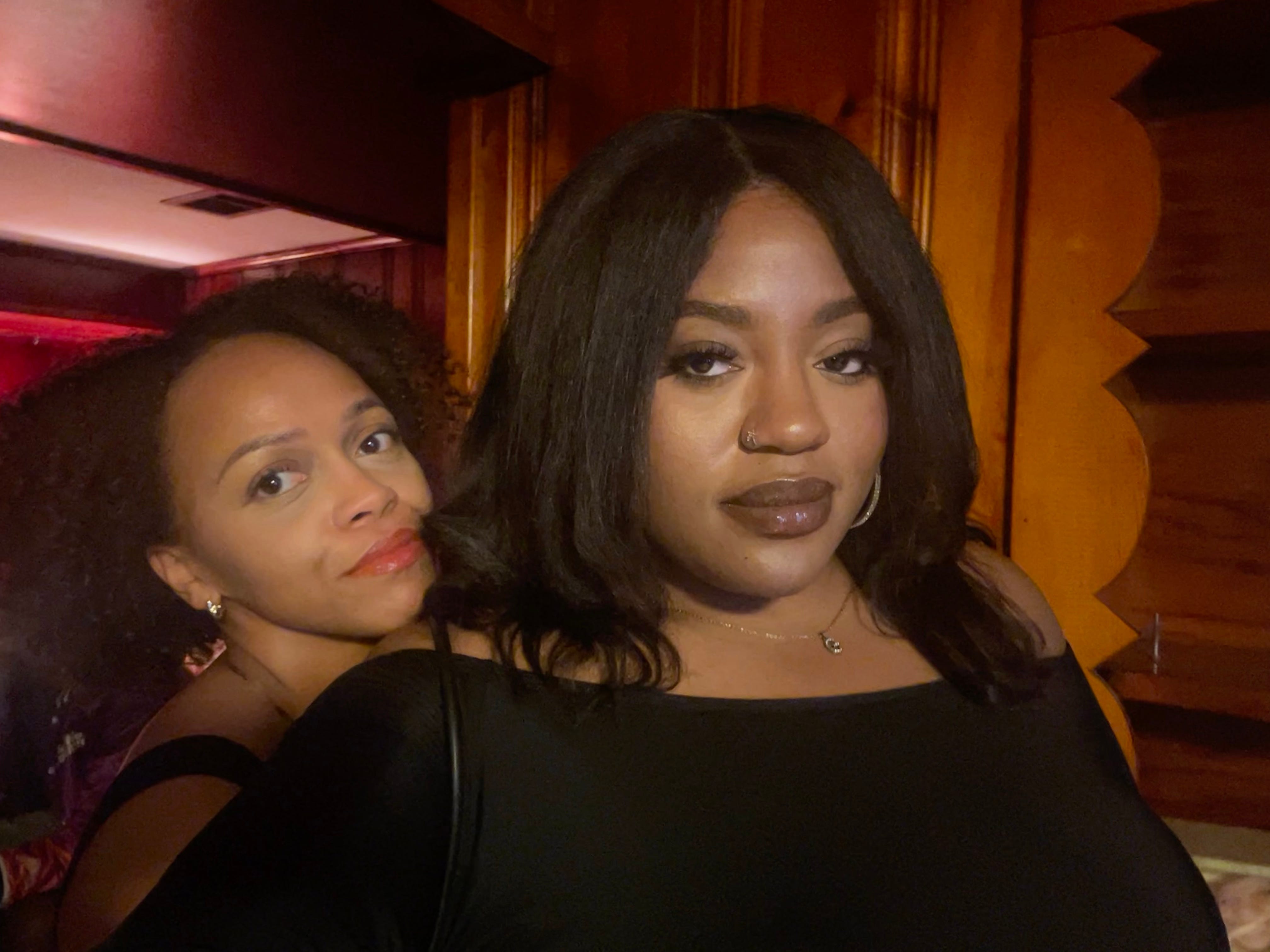
G & G. 💌
P.S. Chicago experienced its first snowfall of the season! The holidays are around the corner, and the nights are getting longer 😣. Stay tuned as we talk mental health and ‘tis-ing the season in the city. ❄️